Free. No account or sales call is required to receive the fit result.
What the report looks like
The executive summary page from a fictional example, so you can see the output without a customer result being shown. Its decision reads “Not recommended for production in its current state”, followed by the three risks that drive it and the three actions that would change it.
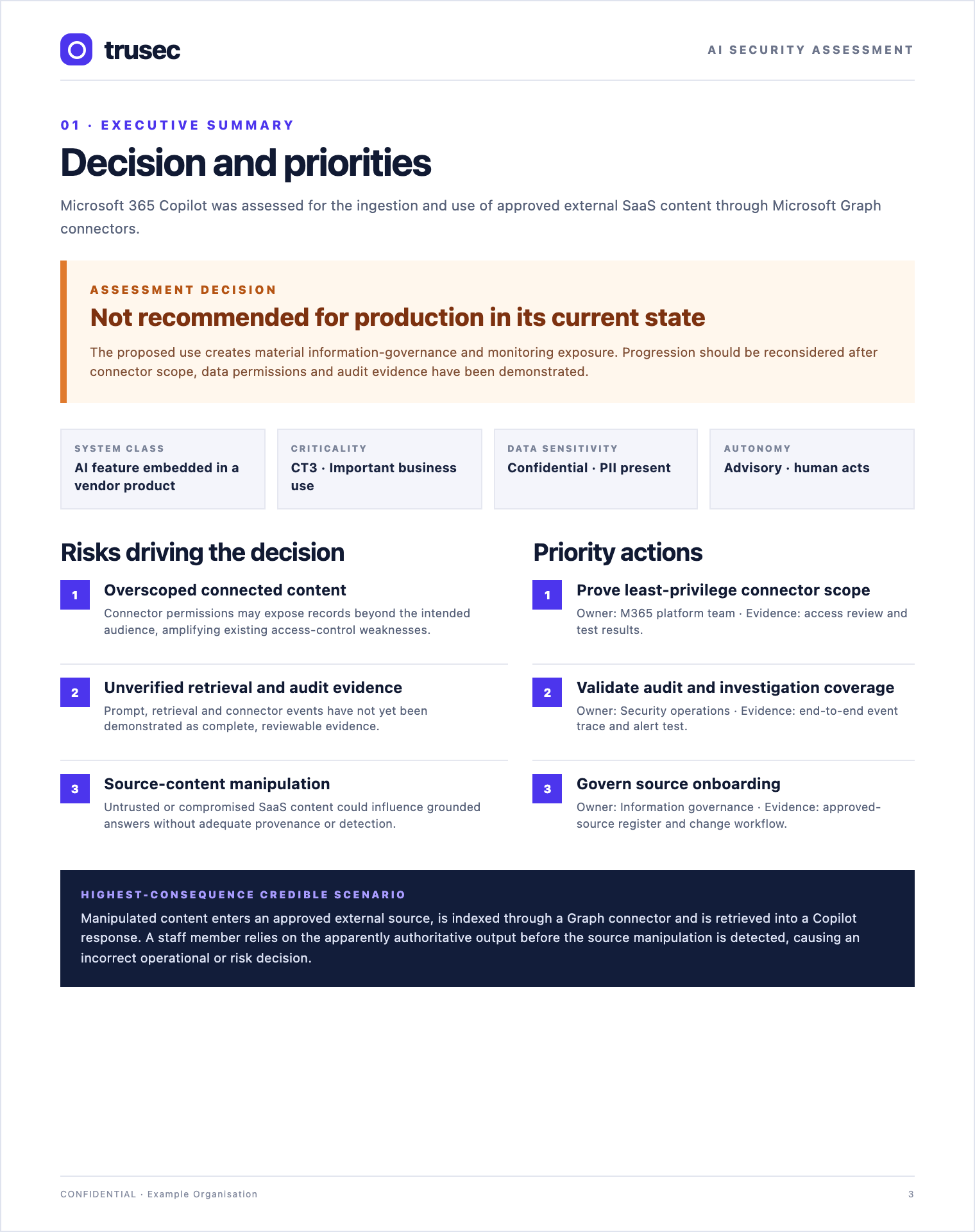
Risk 1, “Overscoped connected content”, names the weakness in one line: connector permissions may expose records beyond the intended audience. It sits first because it drives the decision.
The decision box says what must be demonstrated before progression: connector scope, data permissions and audit evidence. Risk 2 is that gap stated plainly: prompt, retrieval and connector events not yet shown as reviewable evidence.
Priority action 1, “Prove least-privilege connector scope”, carries its owner (the M365 platform team) and the evidence that closes it (an access review and test results). The full backlog continues in the report.
The report overview lists what every section contains.
What you use it for
Use reviewed findings, with the supporting facts and assumptions made clear, to support your responses to an enterprise customer's AI security review.
See the control gaps and the abuse paths in the architecture, and get the fixes ordered by decision impact before launch.
Give them a readiness decision, the material risks and the conditions on one page.
Use the findings to scope a red team to the paths that matter, or to see what to fix before an auditor arrives. This is one use of the report, not a requirement.
Who reviews it, and the scope
An authorised trusec.ai reviewer approves every report before it is released and is accountable for that release. The review checks that each finding rests on the facts you confirmed, that assumptions are labelled as assumptions, that the evidence still needed is named, and that the actions are ordered by decision impact. The technical controls behind that gate, including reviewer authentication and package integrity, are on the security page.
Your remedies are written down before you pay. For a change of mind, you may request a full refund before submitting your intake. After submission, full or partial refunds are discretionary based on work completed and the circumstances. If trusec.ai cannot deliver, we refund the unperformed portion, or the full payment if no useful service was supplied. Refunds return to the original payment method. Your Australian Consumer Law rights are unaffected. Contact support@trusec.ai. The full assessment terms apply.
How it compares with the other ways to get AI security evidence
Six routes answer different questions and are often used together. Each card shows the short version; open it for what you receive, what it needs, its limits and the published price bands. Ranges observed 16 September 2026; third-party figures are in their authors' own currencies and are not quotes.
Self-assessment questionnaireFor example Vanta's AI Security Assessment template download- When you need it
- Starting an inventory, no budget yet
- Indicative price
- No price stated (download)
- Time
- Hours
What you receive, what it needs, limits and price bands
- What you receive:
- Your own answers to a standard question set, mapped to frameworks.
- What it needs from you:
- Your time.
- Limits:
- Nobody reviews your answers; it says nothing about your specific architecture.
- Published pricing:
- The cited page offers a form download and states no price.
AI Security Readiness Assessmenttrusec.ai · one defined system at one point in time- When you need it
- A decision on one system is due
- Indicative price
- A$3,500
- Time
- Five business days from payment
What you receive, what it needs, limits and price bands
- What you receive:
- A reviewed report: readiness status, prioritised findings, threat model summary, control and evidence gaps, remediation backlog, walkthrough, up to three written questions.
- What it needs from you:
- A structured intake of facts you confirm plus documents for extraction; no secrets, credentials or live access.
- Limits:
- No penetration testing, code review, runtime monitoring, certification or assurance sign-off. See the scope statement above.
- Published pricing:
- Fixed price, published on the pricing page.
AI security assessment from a platform vendor's services teamFor example CrowdStrike's AI Systems Security Assessment or Palo Alto Networks' Unit 42 AI Security Assessment- When you need it
- A vendor-led engagement, from discovering AI use across the environment to application-level review
- Indicative price
- Contact sales; no price published
- Time
- Not published
What you receive, what it needs, limits and price bands
- What you receive:
- CrowdStrike: discovery of AI use, including shadow AI, through its platform telemetry; expert evaluation of architecture, data access, configurations and user controls; a summary report with technical findings, strategic recommendations and prioritised actions; stakeholder workshops. Unit 42: plan, explore, evaluate and activate, ending in a threat-informed report and a risk-prioritised roadmap.
- What it needs from you:
- A consulting engagement scoped with the vendor. CrowdStrike's discovery uses its platform telemetry; Unit 42's steps include workshops with your team.
- Limits:
- Neither page publishes a price or a duration. Scope is agreed in the engagement; the pages describe discovery, architecture and configuration review, application threat modelling and governance.
- Published pricing:
- Neither CrowdStrike nor Palo Alto Networks publishes a price or a duration for the service; both pages end in a contact request.
Automated adversarial scanAutomated red-teaming tools and services- When you need it
- Testing evidence for one application, quickly
- Indicative price
- From about US$5,000
- Time
- Days to two weeks
What you receive, what it needs, limits and price bands
- What you receive:
- Results from adversarial probes against the live application; the cited tiers list compliance-mapped, audit-ready findings with human oversight from the standard tier.
- What it needs from you:
- API or interface access to the running system.
- Limits:
- Scope and exclusions vary by package; check the quote for what is reviewed beyond the probes.
- Published pricing:
- AI Vyuh publishes US$5,000–10,000 (quick scan), US$10,000–20,000 (standard) and US$20,000–25,000 (deep dive with retest).
Human-led AI red team or penetration testSecurity consultancies and specialist AI testing firms- When you need it
- Deep technical assurance before a high-risk release
- Indicative price
- From about US$8,000 (survey)
- Time
- One to eight weeks
What you receive, what it needs, limits and price bands
- What you receive:
- Findings with reproducible payloads and remediation guidance; a retest where the engagement includes one.
- What it needs from you:
- Scoped access and time from your engineers.
- Limits:
- Tests what is in scope on the day; no management-system view.
- Published pricing:
- A published survey citing Mindgard data: simple chatbot US$8,000–15,000; RAG US$15,000–35,000; tool-using agent US$25,000–60,000; multi-agent US$50,000–150,000 and above; MCP-connected agent ecosystem from US$60,000. Rate cards: Pentest Testing Corp from US$9,500; DSE from US$18,000 with a US$12,000–18,000 fee band on the same page.
CertificationISO/IEC 42001, or AIUC-1 for AI agents- When you need it
- A contract, customer or market requires a certificate
- Indicative price
- US$15,000–40,000 first year (ISO 42001, small organisation)
- Time
- Months
What you receive, what it needs, limits and price bands
- What you receive:
- An audited AI management system, or a certified agent, from an accredited auditor.
- What it needs from you:
- Implementation, documentation and audit time across the organisation.
- Limits:
- The scope is the organisation or the agent programme, not a quick answer for one system.
- Published pricing:
- Compyl: outsourced gap assessment US$5,000–20,000 (small US$0–8,000, mid-size US$5,000–15,000, enterprise US$10,000–25,000); typical first-year total US$15,000–40,000 for a small organisation with one or two AI systems in scope. AIUC-1 publishes no price on its site.
Questions buyers ask
No. The assessment reviews one defined system from the facts you confirm and the architecture you describe. It does not test the running system, review code or monitor it in production, and the report says so. If your requirement is testing evidence, budget for testing as well.
Because the scope is different, not discounted: one system, a structured intake, no testing, five business days, a reviewed report. If your requirement is adversarial testing, this is not it, and the free fit check exists so you find that out before paying.
No. Certification audits a management system across an organisation and only an accredited auditor can issue it. The assessment tells you where one system stands and what to fix first.
That is their decision. The report states its scope, the facts it relies on, the assumptions it makes and what was not examined, so a reviewer can judge what it covers. If you are unsure, ask them what evidence they accept before you buy.
Sources for the published ranges
- Vanta AI Security Assessment template
- CrowdStrike AI Systems Security Assessment
- Palo Alto Networks Unit 42 AI Security Assessment
- SentinelOne, AI Security Assessment: Step-by-Step Framework (an article describing what an assessment contains)
- AI red-teaming pricing by system type, AI Vyuh, April 2026
- AI penetration testing pricing guide, Pentest Testing Corp
- AI security assessment fees, DSE
- ISO 42001 certification cost, Compyl
- AIUC-1 standard
Third-party prices are the ranges their authors publish, in their own currencies, and change without notice. They are not quotes, and trusec.aidoes not endorse or verify those services. Vendor names identify the routes; each remains its owner's trademark.